
Cloudflare Crypto Outage: Analysis, Background & the DePIN Solution





Key Takeaways
- Centralization as an Achilles' heel: A single error at Cloudflare—one of only a few critical infrastructure providers—paralyzed dozens of crypto platforms for hours.
- Systemic risks for crypto: Despite decentralized blockchain technology, most users rely on centralized frontends to access services like Coinbase, Kraken, and Etherscan.
- DePIN as a solution: Decentralized Physical Infrastructure Networks could reduce reliance on single points of failure.
- Need for redundancy: Multi-cloud strategies and redundant systems are essential for critical services.
- Technical prevention possible: Cloudflare has announced concrete improvement measures, but structural centralization issues remain.
Introduction
What happens when a single infrastructure provider controls half the internet and suddenly goes offline?
On November 18, 2025, millions of users worldwide experienced exactly this scenario. A technical error at Cloudflare not only took down X and ChatGPT, but also brought large parts of the crypto industry to a standstill.
Coinbase, Kraken, Etherscan, and at least ten other crypto platforms were unreachable for hours.
The incident clearly demonstrates how dependent even decentralized crypto systems are on centralized internet infrastructure—and reignites the debate surrounding true decentralization of infrastructure.

The Trigger: Technical Error in the Bot Management System
The cause of the Cloudflare outage was not a cyberattack, but an internal configuration error.
A faulty change to database permissions led to a chain reaction that paralyzed the entire network. The affected system was part of Cloudflare's bot management infrastructure, which uses machine learning to generate bot scores for every request.
The faulty database query produced duplicate entries in a feature file, causing its size to double.
This file was automatically distributed to all servers in the global Cloudflare network, which handles about 20 percent of global internet traffic.
The software running on the servers had a hard-coded size limit for this file. When the doubled file exceeded this limit, the systems crashed and produced the HTTP 500 Internal Server Error.
Overview of Affected Crypto Platforms
The Cloudflare outage hit the crypto industry hard, as many centralized trading platforms rely on their infrastructure services.
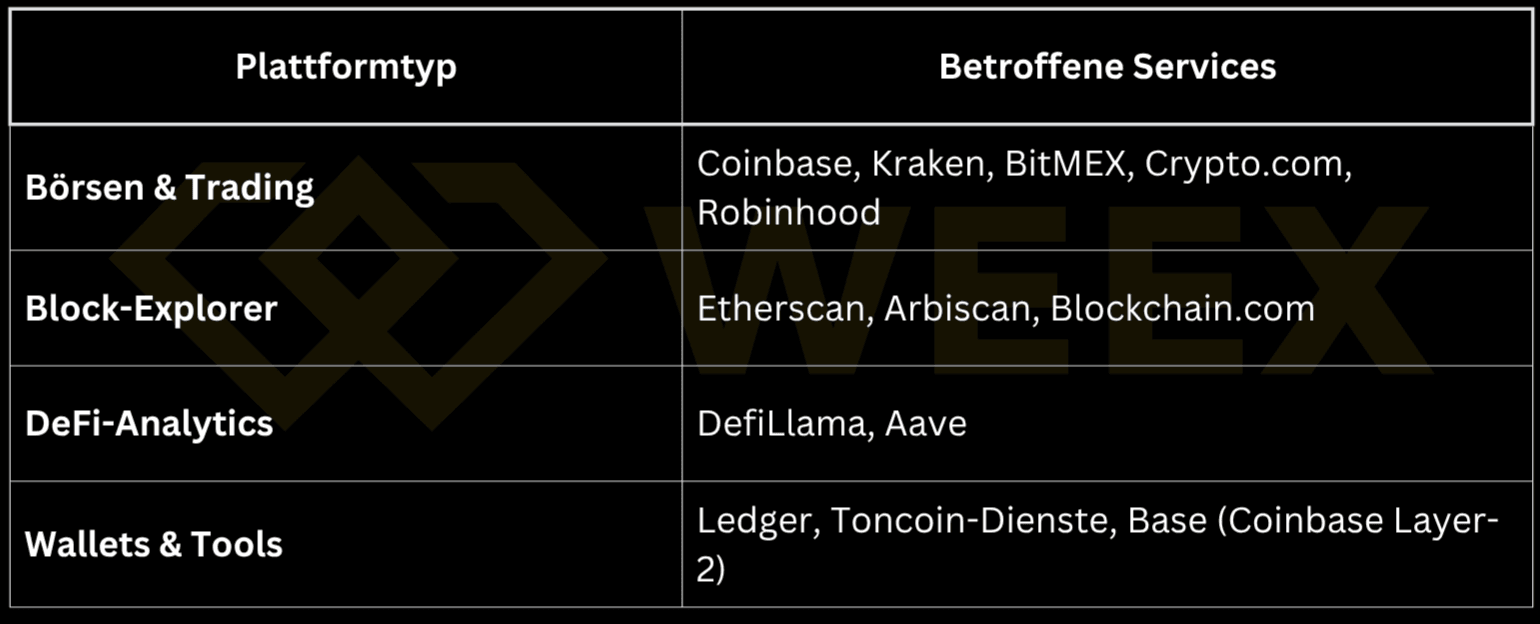
For hours, users saw only error messages and could neither trade nor view their account balances.
It was particularly critical that Bitcoin and Ethereum trading platforms, as heavyweights of crypto trading, were affected.
Although the underlying blockchain protocols continued to function, the centralized frontends and web interfaces were unreachable for hours.
Timeline and Market Impact
The outage began on November 18, 2025, at approximately 11:20 AM CET and was not fully resolved until around 4:30 PM—a total duration of more than four hours.
Traders could not adjust their positions, set stop-loss orders, or execute new trades.
The disruption occurred during a period of increased market volatility, which further exacerbated the situation.
Cloudflare's stock reacted promptly, falling by 3.5 to 3.9 percent in pre-market trading.
This showed how seriously investors viewed the reputational risk and the technical criticality of the infrastructure.
Centralization as a Systemic Problem in Crypto
The Cloudflare outage exposed a fundamental vulnerability: despite decentralized blockchain protocols, most services are dependent on centralized infrastructure providers.
Cloudflare handles about one-fifth of all global internet traffic—an extreme concentration of power in the hands of a single company.
Most crypto users access decentralized protocols via centralized frontends.
Even if smart contracts run on the blockchain, users cannot access them without functional frontend infrastructure.
The outage is part of a series of similar incidents. In October 2025, an AWS outage caused Coinbase's Base app to temporarily display zero balances.
Cloudflare had already experienced similar disruptions in June 2022 and July 2019.
This accumulation is no coincidence, but the result of the increasing centralization of internet architecture.
DePIN: Decentralized Infrastructure as a Solution
The Cloudflare outage has reignited the discussion around DePIN—Decentralized Physical Infrastructure Networks.
DePIN uses blockchain technology and token incentives to coordinate people in building real-world infrastructure.
This can include wireless networks, sensors, energy systems, or computing resources.
The goal is to no longer be dependent on a single centralized company.
Users contribute hardware or services and receive tokens in return, creating an open, community-operated infrastructure layer.
Several DePIN projects are already working on decentralized alternatives. Gaimin, a DePIN project for cloud infrastructure, utilizes underutilized PCs worldwide.
Filecoin offers decentralized storage solutions where providers can rent out storage space.
Helium is building a decentralized Wi-Fi network.
These projects demonstrate that true decentralization is also possible at the infrastructure level.
Buy Filecoin, Helium, and other DePIN coins on WEEX now
Cloudflare's Improvement Measures and Future
Following the incident, Cloudflare announced concrete steps to prevent similar outages.
The company intends to harden the ingestion of configuration files and activate additional global kill switches for features.
Furthermore, all failure modes in the core proxy modules are to be reviewed.
Hardening memory pre-allocation limits and better validation mechanisms are on the agenda.
CEO Matthew Prince publicly apologized for the impact.
Nevertheless, the fundamental dependency on Cloudflare and similar providers remains.
Conclusion
The Cloudflare outage on November 18, 2025, clearly showed how vulnerable even the decentralized crypto ecosystem is to centralized infrastructure failures.
A single configuration error paralyzed dozens of important crypto platforms and highlighted the extreme concentration of critical internet infrastructure.
The crypto industry faces the challenge of fulfilling its decentralization promises at the infrastructure level as well—not just at the protocol level.
Only through multi-cloud strategies, redundant systems, and the development of true DePIN solutions can we prevent a technical error at an infrastructure provider from endangering the vision of a decentralized digital economy.
The coming months will show whether the crypto industry draws consequences from this incident and increases its infrastructure resilience.
FAQ – Frequently Asked Questions
What was the exact cause of the Cloudflare outage?
A configuration error in the bot management system caused a feature file to grow to double its size, leading to global system crashes and HTTP 500 error messages.
How long was the outage active?
The outage began on November 18, 2025, at approximately 11:20 AM CET and was resolved by about 4:30 PM—over four hours.
Which well-known crypto exchanges were affected?
Coinbase, Kraken, BitMEX, Crypto.com, Etherscan, Ledger, DefiLlama, and many other crypto services were temporarily unreachable.
Were the blockchains themselves paralyzed?
No, the underlying blockchain protocols continued to function. Only the centralized frontends and web interfaces were unreachable.
What is DePIN and how does it help with such outages?
DePIN (Decentralized Physical Infrastructure Networks) uses blockchain to build and operate physical infrastructure in a decentralized manner, thereby avoiding single points of failure.
WEEX | Rising Star of Crypto Exchanges in the DACH Region
WEEX combines security, innovation, and community with features for beginners and professionals:
Security & Protection
- 1,000 BTC Protection Fund: Self-funded reserve for rapid loss protection in exceptional cases
Trading & Earning
- Auto Earn: Daily automatic USDT earnings with no effort
- Copy Trading: Follow elite traders automatically or apply as an elite trader for additional benefits
- WE-Launch: Early access to new projects—exclusive to WEEX users
Benefits & Rewards
- Promotions & Rewards: Trading competitions and special bonuses for active users
- Affiliate Program: Lifetime commissions from new users—details here
- VIP Benefits: Lowest fees, market insights, and personal support for high-volume traders
- WXT Token: Fee discounts, airdrops, and exclusive platform benefits
Discover current trends on WEEX Spot and start now: Register now
Disclaimer – Legal Notice from WEEX Exchange
WEEX and its affiliates offer services for the exchange of digital assets, including derivatives and margin trading, only where legal and to eligible users. All content is general information, not financial advice—seek independent advice before trading. Trading cryptocurrencies involves high risk and can lead to a total loss. By using WEEX services, you accept all associated risks and terms. Never invest more than you can afford to lose. Further information can be found in our Terms of Use and in the Risk Disclosure.