Cardano or Ethereum in 2026: Which Cryptocurrency Has More Potential?

At the beginning of 2026, the cryptocurrency market is undergoing dynamic changes. Two key blockchains remain at the center of attention: Ethereum and Cardano. Their competition for dominance in the space of decentralized applications (dApps) and smart contracts is attracting the attention of investors and developers worldwide.

Although both projects aim for similar goals, they differ in their approach to development, technology, and operating philosophy. In this article, we will compare Cardano and Ethereum in the context of 2026, analyzing their technical capabilities, ecosystems, staking, applications, and approaches to regulation and governance. Based on this, we will help you assess which cryptocurrency – ADA or ETH – might be a better investment choice in the current market reality.
Read on to find out which cryptocurrency – Cardano or Ethereum – might prove to be a better investment choice in 2026.
Cardano blockchain and Ethereum blockchain in 2026
Ethereum is the oldest blockchain platform supporting smart contracts and decentralized applications. Thanks to its early start, it has built a massive ecosystem of DeFi, NFT, and Web3 projects. Since transitioning to a proof of stake model (Ethereum 2.0), the network has gained energy efficiency, which attracts investors looking for more sustainable solutions.
Cardano, created by Ethereum co-founder Charles Hoskinson, is a blockchain based on academic research and formal code verification methods. The project develops in stages (Byron, Shelley, Goguen, Basho, Voltaire) and in 2026 is developing its governance mechanisms – Voltaire. ADA, the native token of the Cardano network, is gaining popularity as an investment asset and a staking tool.
In terms of market capitalization, Ethereum still outperforms Cardano, but ADA is consistently increasing its share of the cryptocurrency market. Both projects support the development of smart contracts and have growing adoption in the public and private sectors.
Consider which approach – Cardano’s research-based and structural one or Ethereum’s dynamic and mature one – better matches your expectations for blockchain technology.
Comparison of blockchain technology
Consensus mechanism
Since transitioning to a proof of stake model (Ethereum 2.0), Ethereum has significantly reduced its energy consumption and improved its network scalability. Cardano, on the other hand, uses its own Ouroboros protocol, also based on PoS, which ensures a high level of security and exceptionally low energy consumption. Both platforms are considered environmentally friendly, which fits perfectly with the global trend of striving for sustainable technology development.
Smart contracts
Ethereum uses the Solidity language and EVM virtual machines. Cardano, meanwhile, is based on the Plutus and Marlowe languages, offering formal code verification and contract security.
Ethereum developers have more options and tools, but Cardano is gaining importance due to its solid foundations and growing documentation.
Throughput and scalability
Ethereum is implementing layer-two solutions, such as Rollups (zk-Rollups, Optimistic Rollups), which increase the number of transactions per second. Cardano is developing Hydra – a technology that increases network throughput by creating parallel channels. Both projects are focused on increasing scalability without sacrificing decentralization and security.
Technology is the heart of every blockchain – evaluate which solutions are more important to you: security, scalability, or flexibility.
Developer ecosystem
Ethereum boasts one of the largest developer communities in the blockchain world. Thousands of open-source projects, dozens of SDKs and frameworks, and intense activity on GitHub make it the most frequently chosen platform for building decentralized applications.
Cardano focuses on quality and formalism. Although the number of active dApps and tools is smaller than on Ethereum, the ADA community in 2026 is developing dynamically. Projects such as Minswap, World Mobile Token, and Liqwid Finance show that Cardano attracts innovative solutions and is gaining increasing investor trust.
If you are a developer or are interested in building dApps – consider which platform gives you more possibilities.
Applications and adoption
Ethereum dominates the DeFi and NFT space. The platform is integrated with the largest exchanges, wallets, and cryptocurrency services. NFT and Web3 remain the main pillars of its ecosystem.
Cardano focuses on applications in developing countries, education, digital identity, and the public sector. The project has a strong presence in Africa and Latin America, and its partnerships with governments and educational institutions increase the chances for real-world adoption.
Think about which network you believe has a greater impact on the real world and potential for global development.
Staking: ADA vs ETH
Staking ADA is simple and accessible to every user – all you need is a wallet and to choose a staking pool. ADA staking rewards are attractive and predictable, and the delegation model does not require locking funds for a long time.
Staking ETH requires a minimum threshold (32 ETH for a validator) or the use of intermediary services, which increases the risk of centralization. After The Merge, staking became a key mechanism for securing the network, but it raises controversy regarding the level of decentralization.
Consider which form of staking is more transparent, accessible, and profitable for you.
Regulations and risk
Ethereum, as the first smart contract platform, has come under the scrutiny of regulators. The status of ETH as an asset that does not fall into the category of securities still raises controversy, especially after Ethereum's transition to the Proof of Stake model. There is an ongoing debate about whether this change brings ETH closer to the definition of a security under current regulations. Cardano, thanks to its formal development methods and transparent structure, enjoys greater trust from institutions.
Regulatory risk concerns the entire cryptocurrency market, but Cardano's approach – based on science, transparency, and decentralization – may make it easier for it to adapt to future legal requirements.
Take into account the legal stability and transparency of the project – these are important aspects for any long-term investment.
Community and governance
The Ethereum community is one of the largest and most engaged in the crypto world. Developer activity is visible, among other things, during events such as DevCon, and Vitalik Buterin plays a significant role as a visionary and leader. However, network governance is carried out informally, which on one hand speeds up the implementation of innovations, but on the other, can lead to a lack of transparency and internal disputes.
At the same time, Cardano is developing the Voltaire phase – a decentralized governance system that includes a treasury fund and on-chain voting mechanisms. Thanks to this, every holder of ADA tokens can participate in the decision-making process regarding the future of the network. This approach strengthens the democratization of governance, supports transparency, and builds strong engagement within the Cardano community.
Join the Cardano community or the Ethereum community on Reddit and learn the opinions of other users.
Comparison table: Cardano vs Ethereum
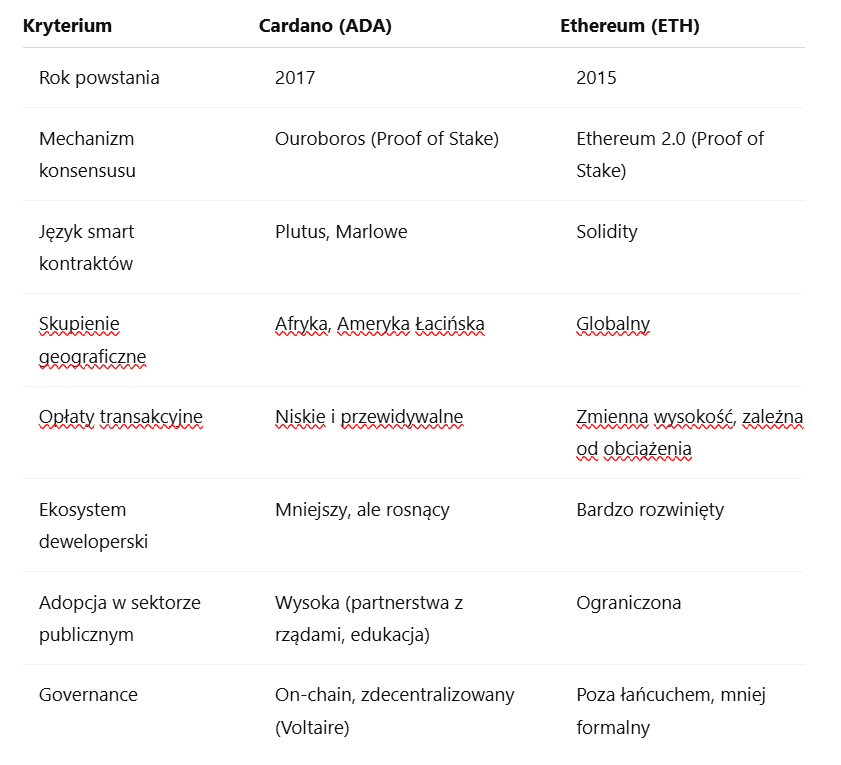
To stay up to date with the development of both projects, it is worth regularly following the official Ethereum and Cardano websites, where updates, development plans, and community announcements are published.
Pros and cons of Cardano (ADA)
Pros:
Very low energy consumption thanks to Ouroboros PoS
Based on scientific research and academic peer reviews
Low fees and a predictable cost model
Transparent, decentralized governance system
Easy and accessible staking for users
Cons:
Smaller ecosystem of dApps and tools than Ethereum
Slower implementation of new features
Less popular in the DeFi and NFT space
Want to know more market data? Check the ADA price on CoinGecko or CoinMarketCap.
Pros and cons of Ethereum (ETH)
Advantages:
Leader position in DeFi and NFT
Extensive developer ecosystem
Support from most exchanges and wallets
Rapid development thanks to Layer 2 solutions
Disadvantages:
High transaction fees (gas fees)
Network congestion during periods of high traffic
Less transparent governance
Controversies related to staking centralization
Want to know more market data? Check the ETH price on CoinGecko or CoinMarketCap.
Summary: Which blockchain has the advantage in 2026?
Cardano offers stability, low fees, and simple governance. Ethereum is an engine of innovation with massive community support. The choice depends on whether you are a long-term investor looking for potential (ADA) or prefer a mature platform with broad application (ETH).
Cardano may catch up to Ethereum, but it will depend on adoption, demand for cryptocurrencies, and collaboration with the real world.
Now that you know the key differences between Cardano and Ethereum, think about which cryptocurrency better suits your strategy and investment goals. Want to start investing today? Learn how to buy ADA or ETH step by step on WEEX.
Frequently Asked Questions
Is Cardano better than Ethereum?
It depends on your needs. Cardano offers more transparent governance and lower fees, while Ethereum has a larger ecosystem and a faster pace of innovation.
Can I use the same dApps on both platforms?
No. dApps are usually built on one specific platform – Cardano or Ethereum – and are not compatible with each other, although some projects are working on versions for both blockchains.
Is staking safer on Cardano or Ethereum?
Both networks use Proof of Stake, but Cardano has a more decentralized and accessible staking system. Ethereum requires higher stakes or the use of intermediary services.
Will Cardano surpass Ethereum?
It is possible, but difficult to predict. Ethereum has the first-mover advantage, but Cardano offers an alternative based on research and transparency. Everything depends on further development and adoption.
Disclaimer
WEEX and its affiliates provide services related to the exchange of digital assets, including trading derivatives and leveraged products, only where legal and for authorized users. All content is for general information purposes and does not constitute financial advice – it is recommended to seek independent advice before starting to trade. Cryptocurrency trading involves high risk and may result in the total loss of funds. By using WEEX services, you accept the associated risks and terms. Never invest more than you can afford to lose. Details can be found in the Terms of Service and Risk Disclosure.