
AI Trading: How to Trade Using AI

AI trading involves using artificial intelligence (AI), machine learning (ML), and algorithms to automate the buying and selling of assets (including cryptocurrencies). Such systems analyze large volumes of market data, react instantly to signals, identify patterns, and predict price movements—tasks that are often too slow or complex for humans to perform manually. Unlike simple algorithms, modern AI trading bots are capable of adapting and learning from new data in real time, accounting for market changes, news, and sentiment.
Popular types of bots
- Spot — trading an asset without leverage.
- Futures — long/short positions with mutual risk control.
- GRID/DCA — grid trading and dollar-cost averaging for sideways markets and gradual entry.
- Arbitrage/Market-making — working with spreads/inefficiencies.
- Sentiment bots — using neural networks for news/social media (risk of data "noise").
Examples of AI trading bots
- Pionex spot/futures trading bot. Bots built into the exchange; simple setup, many tutorials. Suitable for grid strategies without coding.
- 3Commas AI Grid Bot. A standalone service with an AI module for adapting grid parameters; works via API with various exchanges.
- Bitsgap spot/futures trading bots. An aggregator with "AI analytics" and several types of spot trading bots; useful if you have accounts on different exchanges.
- Cryptohopper. Cloud-based bots, a strategy marketplace, and an "AI platform" for automation. Suitable as a universal platform with ready-made presets.
- WunderTrading (AI bots, including grid trading bots). An AI platform that features exchange integrations and presets for grid logic.
- CryptoRobotics. An AI trading bot with periodic retraining and hourly signals; versions available for different exchanges.
What to look for when choosing a bot
AI transparency.
Fees, spreads, slippage. In futures, a mistake in leverage settings costs significantly more.
API security. Read exchange/platform manuals, set minimum permissions, and disable withdrawals via API.
Backtest ≠ future result. Test bots with small amounts and monitor the strategy in real time.
How to trade using AI
Define your trading goal and data
A clearly formulated goal determines which data to collect, how to process it, and which metrics to use to evaluate the strategy or bot.
Trading goal
- Trend trading. Horizon: from hours to days. Objective: capture major upward/downward movements. Key metrics: Sharpe/Sortino ratio, maximum drawdown, MAR ratio (annual return/max drawdown), average R-multiple per trade.
- Scalping. Horizon: seconds to minutes. Objective: extract small inefficiencies. Metrics: execution latency, win rate, profit/loss per trade considering fees and price slippage.
- Arbitrage. Horizon: milliseconds to minutes. Objective: capture price differences between exchanges/markets or instruments (spot↔futures). Metrics: average spread after costs, joint risk volatility, share of unclosed leveraged trades.
- Grid/averaging trading (GRID/DCA). Horizon: days to weeks. Objective: monetize sideways ranges or enter trades in parts. Metrics: return within range, portfolio volatility, grid fill rate.
- Market-making. Horizon: continuous. Objective: earn on spreads and rewards, control position inventory. Metrics: inventory skew, order-to-trade ratio, adverse selection rate (when trading against you).
Set constraints in advance: maximum leverage, acceptable risk per day/trade, trading hours, liquidity limits, expected price slippage, and fees (these differ between spot and futures).
Data
- Market data: open/high/low/close/volume candles, order dynamics, order book depth (Level 2) — spread and buy/sell imbalance, funding rate, open interest, basis (difference between futures and spot).
- Volatility: Average True Range (ATR), historical/realized volatility, "volatility of volatility," regime clustering (low/medium/high).
- Market microstructure: momentum/reversal, impulse duration, cross-signals from dominant pairs.
- On-chain metrics (for coins): exchange inflows/outflows, active addresses, large transfers.
- News and market sentiment: media headlines, social media activity, sentiment indices; for modeling — numerical features (polarity, polarity change, mention intensity).
- Calendar and time: trading sessions, events (hard forks, listings), day of the week, hours of high volatility.
- Target labels:
- Classification: sign/magnitude of profit over k-candles ahead (e.g., return sign with a threshold).
- Regression: continuous return or future spread.
- Event labels: impulse > X, range breakout, basis crossover, etc.
Data quality and sample splitting
- Timestamps: one time zone (e.g., UTC), source synchronization, no "shifts" during time conversion.
- Gap filling: correct gap filling, candle consolidation without predicting the future.
- Candle type: classic time-based or volume/dollar/imbalance-based.
- Splitting into training/validation/test samples over time:
- Do not shuffle observations. Use time-series splitting.
- Walk-forward testing: Train t0→t1 → Validate t1→t2 → Test t2→t3; then the window shifts.
- "Purging" and "embargo": insert a buffer between samples to avoid look-ahead bias (e.g., 1–3× your trading horizon).
- Normalization without prediction: only rolling transformations (e.g., z-score normalization with a rolling window that does not look ahead).
- Anomalies and rollovers: outlier filter, check for strange candles, contract unification during futures transitions.
Features and stability checks
- Rolling statistics: averages/medians, correlations, basic benchmarks (Relative Strength Index – RSI, Moving Average Convergence Divergence – MACD) for fair comparison.
- Volatility-aware features: price/ATR, grid step based on volatility level.
- Microstructure features: order book imbalance, approximate position in the queue, order cancellation/replacement dynamics (if available).
- On-chain/sentiment: lags and smoothing, normalization by mention frequency.
- Stability checks: feature distribution shift index, periodic retraining, tracking the decline in win rate in real time.
Mini-example
- Task: trend strategy for BTC/USDT, 1-hour interval.
- Inputs: open/high/low/close/volume candles, ATR(14), exponential moving averages 3/10, volume, order flow delta, funding rate (1h), open interest (1h).
- Label: return sign for the next 6 hours with a threshold of ±0.25%.
- Risks and constraints: maximum leverage 2×, stop-loss 1.2×ATR, risk 0.5% per trade; fees and expected slippage 0.02%.
- Backtesting: rolling test 2023-01 → 2025-06 with monthly retraining; network outage periods excluded.
Choose a tool and launch
- Ready-made no-code bots — quick start on an exchange or bot service.
- Custom models — more control, but requires machine learning skills, backtesting, walk-forward checks, and a trade journal.
- Launch: start with a small amount, check order execution and slippage, and only then scale up.
Risk control
- Set a risk limit per trade/day; use stop-losses/take-profits.
- Separate capital by strategies; minimize leverage until results are proven.
- Monitor PnL, max drawdown, stability, and hidden risks (API, execution).
How do AI trading bots work?
How an AI trading bot works
1 Data collection: market quotes, volumes, derivative data, news/sentiment.
2 Analysis/modeling: machine learning networks / neural networks look for patterns, form entry/exit signals.
3 Execution: if conditions are met, the bot opens/closes trades automatically via API.
Advantages
- Bots work 24/7, without emotions or fatigue.
- Fast order execution in volatile markets.
- Analysis of large data arrays and complex patterns, strategy optimization.
Risks
- "Black swans," structural market breaks, regime changes.
- Technical/operational risks (API, access rights, account security).
- Model overfitting, data drift.
How to use AI trading in practice
- Arbitrage: finding price discrepancies between exchanges/markets.
- Trend/scalping: following the trend or quick trades on small timeframes.
- Monitoring multiple markets: parallel scanning of dozens of pairs and exchanges.
- Automatic portfolio management: rebalancing, changing asset weights.
What is the WEEX Auto Earn feature and how does it differ from active trading?
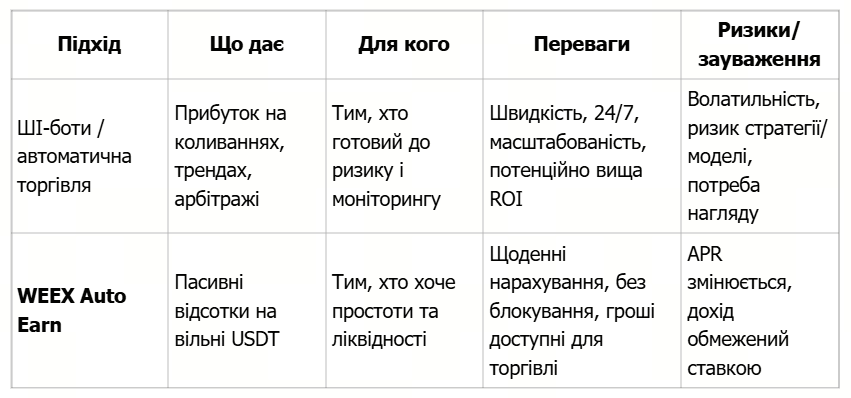
WEEX Auto Earn is NOT a trading bot, but a convenient product for earning passive income from idle USDT assets: daily accruals, no minimum deposit or lock-up period, funds available for trading/withdrawal at any time. Detailed explanations and examples are available in the WEEX Cryptopedia.
- How is this useful for an AI trader? When a bot is waiting for a signal and part of the balance is idle, the Auto Earn feature reduces "downtime": idle USDT assets earn interest while remaining liquid for instant trading.
Comparison: AI bots (active) vs. WEEX Auto Earn (passive)
Getting started on WEEX: "bot + Auto Earn" in three steps
1 Create an account and enable security settings (2FA, anti-phishing code) on WEEX.
2 Set up a strategy/bot (spot, futures, GRID/DCA) and test it with a small amount (demo assets / minimum lot).
3 Enable the Auto Earn feature for USDT in the WEEX app — daily accruals without lock-up, funds remain available for trades.
Frequently Asked Questions
Can AI consistently "beat the market"?
No. AI provides speed, scale, and discipline, but does not guarantee results. Set realistic expectations and manage your risks.
Can I combine an AI trading bot with Auto Earn?
Yes. The balance remains liquid: when there is no signal, USDT earns profit in Auto Earn, and when a signal appears, these funds are available for trading.
What are the minimum amounts and payouts?
The minimum entry and daily calculation/APR depend on the terms at the time of activation. Check the current parameters on the official WEEX website.
Conclusion
AI trading is a synergy of algorithms and risk control. Start simple, avoid "miracle promises," and mix your approach: bots to find opportunities and WEEX Auto Earn for passive earnings on idle USDT. This way, you reduce capital downtime while maintaining liquidity and flexibility.
Don't wait for the perfect moment — create an account on WEEX now and test the "bot + Auto Earn" combination with a small amount.