
Vitalik Revisits Quantum Threat Theory: Is the Foundation of Cryptocurrency Really at Stake?


Original Article Title: "The Resurgence of Quantum Threat, Is the Foundation of Cryptocurrency Shaken?"
Original Article Author: Azuma, Odaily Planet Daily
Lately, the threat of quantum computing to cryptocurrency has once again become a hot topic of discussion online. The reason behind this renewed interest is that several key figures in the quantum computing and cryptocurrency industries have recently made new predictions regarding the development of quantum computing and its potential capabilities.
Firstly, on November 13th, Scott Aaronson, a quantum computing guru and Director of the University of Texas Quantum Information Center, mentioned in an article: "I now believe that before the next US presidential election, we may have a fault-tolerant quantum computer capable of running the Shor algorithm..."
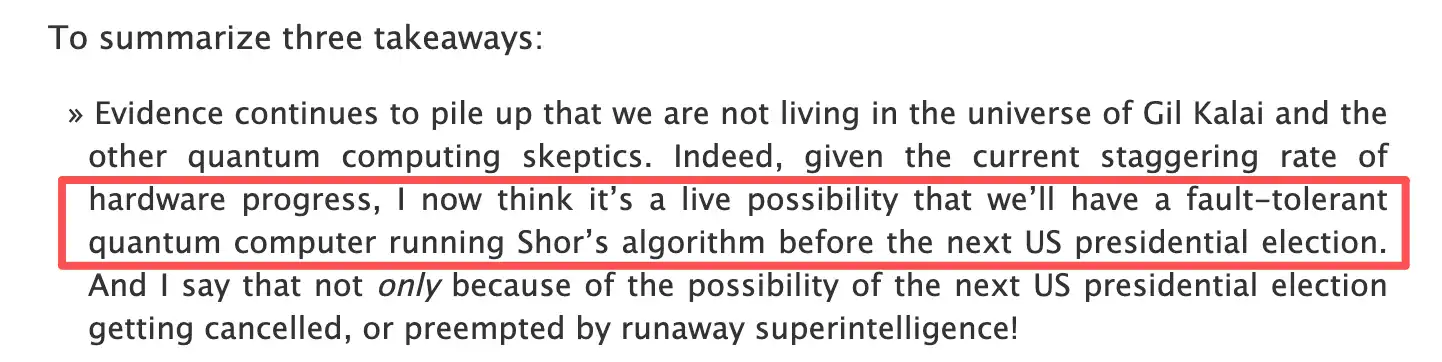
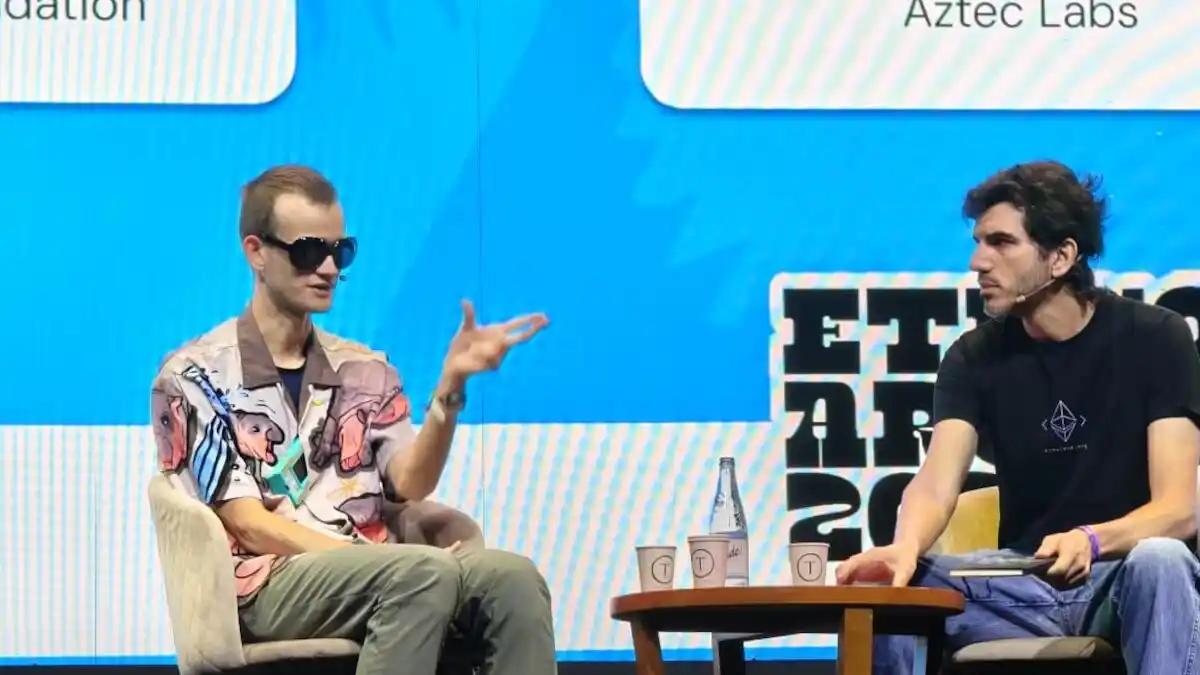
Following that, on November 19th, Ethereum co-founder Vitalik Buterin also spoke at the Devconnect conference in Buenos Aires, stating that Elliptic Curve Cryptography (ECC) could be broken by quantum computing by the US presidential election in 2028, and urged Ethereum to upgrade to a post-quantum algorithm within four years.
What is a Quantum Threat?
Before we interpret Scott and Vitalik's predictions, we need to briefly explain what a "quantum threat" is.
In simple terms, a quantum threat to cryptocurrency refers to the possibility that a sufficiently powerful quantum computer in the future could break the cryptographic foundations protecting the security of current cryptocurrencies, potentially undermining their security model.
Currently, the security of almost all cryptocurrencies (such as Bitcoin and Ethereum) relies on a technology known as "asymmetric encryption," with the two most critical parts being the "private key" and the "public key":
• Private Key: Kept secret by the user, used to sign transactions and prove ownership of assets;
• Public Key: Generated from the private key, can be made public, and is used as a wallet address or part of an address.
The cornerstone of cryptocurrency security lies in the fact that deriving a private key from a public key is currently computationally infeasible. However, quantum computing, leveraging principles of quantum mechanics, can greatly expedite the process of solving certain mathematical problems by running specific algorithms (such as the aforementioned Shor's algorithm), which is precisely the weakness of asymmetric encryption.
Let's further explain what Shor's algorithm is. We won't delve too much into the mathematics here, but in essence, the essence of Shor's algorithm is that it can transform a mathematical problem that is "almost unsolvable" on a classical computer into a "relatively solvable" period-finding problem on a quantum computer, potentially threatening the existing "private key - public key" cryptographic system of cryptocurrency.
For a more straightforward example, you can easily turn a basket of strawberries (analogous to a private key) into jam (analogous to a public key), but obviously cannot reverse the jam back into strawberries. However, suddenly a cheat code (analogous to quantum computing) emerges that may be able to achieve this expediently (analogous to the Shor's algorithm).
Has the Foundation of Cryptocurrency Been Shaken?
So, does this mean cryptocurrency is doomed?
Don't panic, the quantum threat is objectively real, but the issue is not as pressing. The reason for this statement mainly lies in two key points. First, there is still time before a real threat emerges; second, cryptocurrency can implement post-quantum algorithms through upgrades.
Firstly, regarding the first point, even if Scott's prediction comes true before the 2028 elections, it does not mean that cryptocurrency security will truly be compromised; Vitalik's statement is not suggesting that the foundation of Bitcoin and Ethereum will be shaken but merely points out a theoretical risk in the long term.
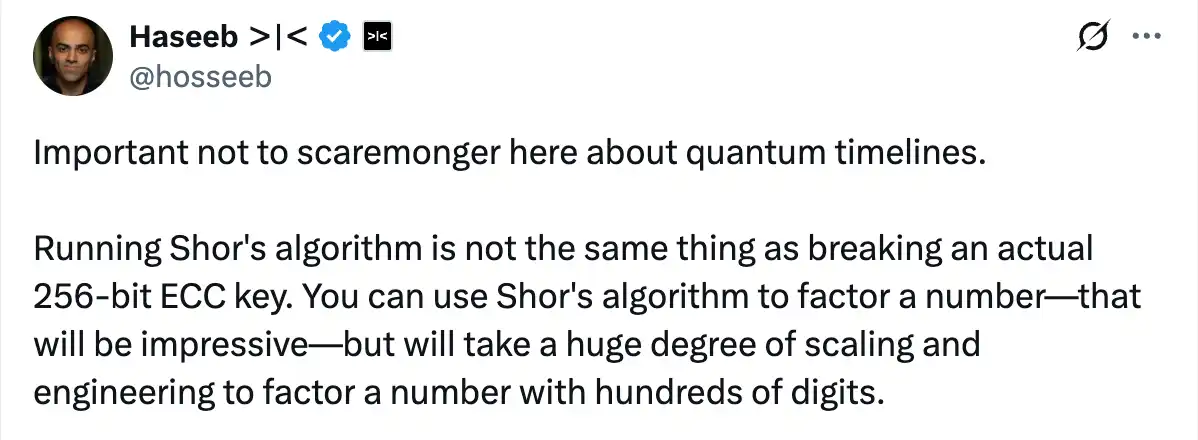
Haseeb, a Dragonfly Capital partner, explained that there is no need to panic about the new timeline for quantum computing, running Shor's algorithm does not equate to breaking a real 256-bit elliptic curve key (ECC key). You can use Shor's algorithm to break one number—that's impressive enough—but breaking down a number with hundreds of digits requires a significantly larger computational scale and engineering capacity... This is something to take seriously but is by no means imminent.
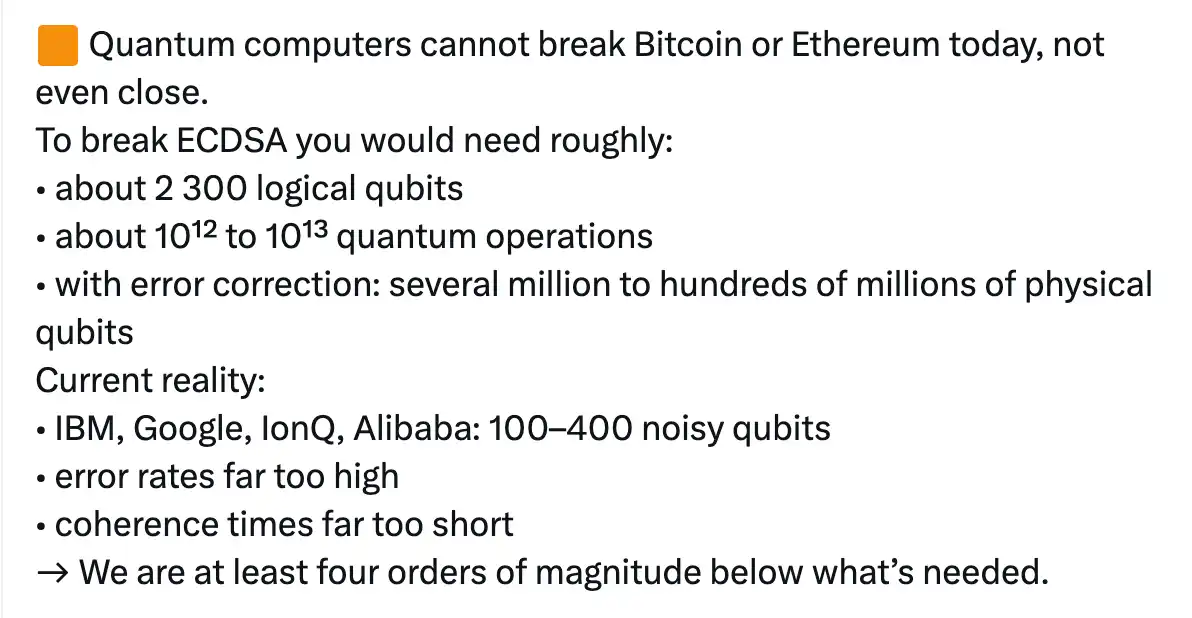
Cryptocurrency security expert MASTR has provided a clearer mathematical answer. Breaking the elliptic curve signature (ECDSA) currently used in cryptocurrencies such as Bitcoin and Ethereum would require approximately 2300 logical qubits, 10¹² to 10¹³ quantum operations, and, with error correction, would require millions to even billions of physical qubits. However, current quantum computers only have 100 to 400 noisy qubits with a high error rate and a short coherence time—the gap between the requirements to break the former is still at least four orders of magnitude.
As for the second point, industry cryptographers are also developing new post-quantum cryptography (PQC) algorithms that can resist quantum computing attacks, and mainstream blockchains have already prepared for this.
As early as March last year, Vitalik wrote an article titled "If Quantum Attack Comes Tomorrow, How Will Ethereum Solve It?" In the article, he mentioned the resilience to quantum threats of Winternitz signatures, STARKs, and even envisioned how Ethereum would urgently upgrade in case of an emergency.
Compared to Ethereum, Bitcoin may not be as flexible in upgrade implementation, but the community has long proposed various potential algorithm upgrade solutions such as Dilithium, Falcon, SPHINCS+. With the recent increase in related discussions, Bitcoin OG figure Adam Back has also stated that post-quantum cryptographic standards can be implemented long before a substantial quantum computing threat emerges.
In summary, the quantum threat is like a distant "master key" that theoretically can unlock all current blockchain cryptographic locks. However, the creators of the locks have long been studying new locks that this master key cannot open and are preparing to replace all the doors with new locks before the master key is created.
This is the current objective reality regarding the quantum threat. We cannot ignore its progress, but there is no need to blind panic because of it.
You may also like

Morning Report | CoinEx becomes a key hub for Iran to evade sanctions, involving over $3.8 billion in funds; Kalshi seeks a new round of financing, with a valuation potentially rising to $40 billion

From the white-haired stock god to the billionaire fund mogul, the smart people shorting Nvidia are all getting rich using the same framework

Why do cryptocurrency projects always like to change their names?

Global Launch: As predictions become the most scarce asset in the AI era, Manadia is defining the next generation of the value internet

Who is footing the bill for the $64 billion accounting frenzy?
I never expected that the first application of AI x Crypto would be in security auditing

What is your view on Binance's competitive advantages?

ETH has entered a non-consensus phase, and the turning point is approaching!
The shift in the cloud of the air: from despising stablecoins a year ago to the high-profile entry of capital today
The survival dilemma of small and medium exchanges behind the withdrawal anomalies exposed by AscendEX

Why Is Bitcoin Falling Below $60K? 5 Key Market Drivers Explained
Bitcoin has dropped sharply amid ETF outflows, Strategy stock weakness, AI stock rallies, and changing Fed expectations. Explore the key forces driving BTC’s latest correction and what traders should watch next.

Bitcoin vs. Gold in 2026: Which Asset Performs Better in Different Markets?

Morning News | The draft amendment to the People's Bank of China Law aims to clarify the legal status of digital renminbi; South Korea will transfer about 40 unregistered virtual asset service providers to law enforcement agencies
The cryptocurrency industry has entered the "Show Me" era: merely relying on vision is no longer enough

Interpreting the Ethereum Foundation's new structure: Reaffirming self-sovereignty amid institutional trends
Former SpaceX engineer reconstructs the financial execution system using first principles
Standard Chartered Bank sings a 50x rhapsody again, aiming for AAVE to reach 3500 USD

Tidal Investment: We still have a positive outlook on the AI industry chain, but the reasons have changed
Morning Report | CoinEx becomes a key hub for Iran to evade sanctions, involving over $3.8 billion in funds; Kalshi seeks a new round of financing, with a valuation potentially rising to $40 billion
From the white-haired stock god to the billionaire fund mogul, the smart people shorting Nvidia are all getting rich using the same framework
Why do cryptocurrency projects always like to change their names?
Global Launch: As predictions become the most scarce asset in the AI era, Manadia is defining the next generation of the value internet
Who is footing the bill for the $64 billion accounting frenzy?
I never expected that the first application of AI x Crypto would be in security auditing


