
The first stablecoin issuer Circle is quickly plummeting back to its opening price. What is the market worried about?

Original Author: Rubin, Top Influencer in the Knowledge Power List for Economics and Management
Editor's Note: This article is excerpted from a roundtable event on "Penetrating Stablecoins" jointly hosted by Zhihu and BlockBeats. The roundtable has accumulated over 26 million views since its launch, attracting widespread attention from both within and outside the industry. The event aims to present the latest developments, key mechanisms, and future trends of stablecoins to the public in a more intuitive and systematic manner.
Roundtable Link: https://www.zhihu.com/roundtable/stablecoin
The following is the original content:
Circle this quarter seems like a pig flying high on the high-interest rate trend, but the market is worried the wind direction may change:
Narrowing spreads, rising costs, single-profit business, regulatory uncertainty;
With these headwinds, companies flying high may also be prone to quick falls.
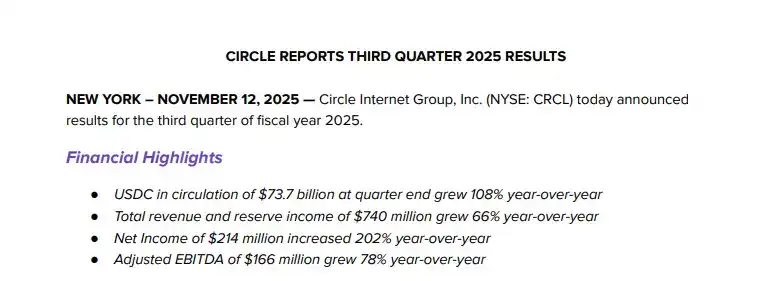
Imagine the stock market as a "marathon-style gamble," where yesterday player Circle rushed through a mid-race aid station (Q3) and achieved a good profit result. However, after investors reviewed the report, they believed that the upcoming slope, player pace, and aid may not be sustainable, leading to selling and causing a price drop.
1) Investors Focus More on the "Future"
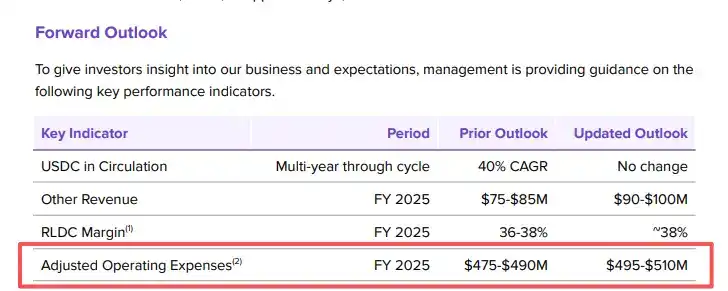
Although Circle significantly exceeded expectations in Q3, it also raised its full-year operating expense forecast ($495–510M). This implies that the company's future profit growth rate may be "eaten up," making it unable to achieve high profits again.
2) Reserve Yield Declining
Companies like Circle, which operate stablecoins, make a significant portion of their earnings through:
Issuing stablecoins, users buying stablecoins, and the company receiving dollars to purchase conservative asset investments such as government bonds/short-term notes
Take the spread without paying interest through this method.
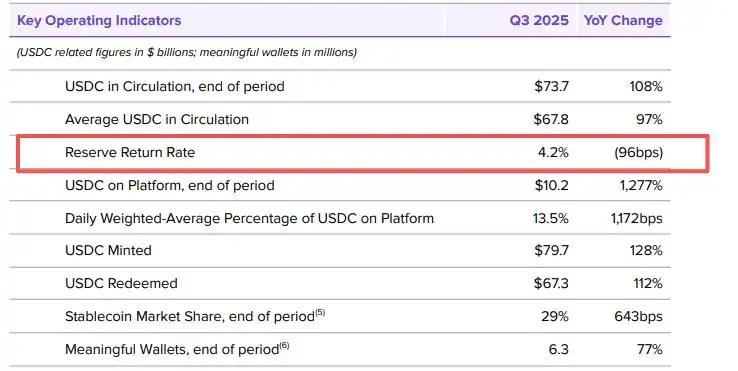
A report shows that although the total amount of reserve income is large, the reserve's simple interest return has decreased by approximately 96 bps.
If market interest rates decline or short-term yields compress, this profit-making method will significantly shrink in the future, directly impacting earnings.
3) Income Highly Relies on "Reserve Income"
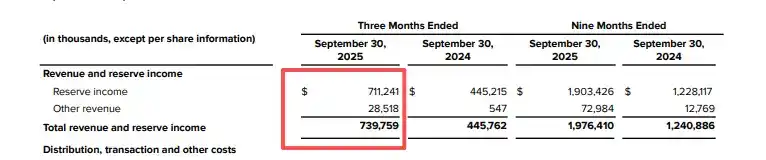
Out of Q3's $740M, the vast majority comes from reserve income ($711M), while "other income" (subscriptions, services, transactions, etc.) is only $29M.
This means that Circle's current business is more like a large treasury that doesn't need to pay interest to users, rather than a traditional SaaS or payment company;
When the market is concerned about narrowing spreads or regulatory impact, this single-income model will be discounted.
4) Regulatory and Policy Risks
Stablecoins are closely related to reserve assets, and any regulation (such as strict rules from the U.S. Congress/regulators on stablecoins) or on reserve assets (such as restrictions on holding government bonds/short-term notes) will affect revenue expectations.
During regulatory uncertainty, investors often demand a higher risk premium, leading to sell-offs and stock price declines.
In fact, Circle is currently in a delicate stage:
Its profit model is sound, its compliance foundation is solid, but the growth story is losing momentum.
Perhaps in the eyes of many traditional investors, it is more like a "dollar fund company," making safe but unimaginative money.
You may also like

The large models in the United States are moving towards closure in the name of security

Morning Report | CoinEx becomes a key hub for Iran to evade sanctions, involving over $3.8 billion in funds; Kalshi seeks a new round of financing, with a valuation potentially rising to $40 billion

From the white-haired stock god to the billionaire fund mogul, the smart people shorting Nvidia are all getting rich using the same framework

Why do cryptocurrency projects always like to change their names?

Global Launch: As predictions become the most scarce asset in the AI era, Manadia is defining the next generation of the value internet

Who is footing the bill for the $64 billion accounting frenzy?
I never expected that the first application of AI x Crypto would be in security auditing

What is your view on Binance's competitive advantages?

ETH has entered a non-consensus phase, and the turning point is approaching!
The shift in the cloud of the air: from despising stablecoins a year ago to the high-profile entry of capital today
The survival dilemma of small and medium exchanges behind the withdrawal anomalies exposed by AscendEX
Why Is Bitcoin Falling Below $60K? 5 Key Market Drivers Explained
Bitcoin has dropped sharply amid ETF outflows, Strategy stock weakness, AI stock rallies, and changing Fed expectations. Explore the key forces driving BTC’s latest correction and what traders should watch next.

Bitcoin vs. Gold in 2026: Which Asset Performs Better in Different Markets?

Morning News | The draft amendment to the People's Bank of China Law aims to clarify the legal status of digital renminbi; South Korea will transfer about 40 unregistered virtual asset service providers to law enforcement agencies
The cryptocurrency industry has entered the "Show Me" era: merely relying on vision is no longer enough

Interpreting the Ethereum Foundation's new structure: Reaffirming self-sovereignty amid institutional trends
Former SpaceX engineer reconstructs the financial execution system using first principles
Standard Chartered Bank sings a 50x rhapsody again, aiming for AAVE to reach 3500 USD
The large models in the United States are moving towards closure in the name of security
Morning Report | CoinEx becomes a key hub for Iran to evade sanctions, involving over $3.8 billion in funds; Kalshi seeks a new round of financing, with a valuation potentially rising to $40 billion
From the white-haired stock god to the billionaire fund mogul, the smart people shorting Nvidia are all getting rich using the same framework
Why do cryptocurrency projects always like to change their names?
Global Launch: As predictions become the most scarce asset in the AI era, Manadia is defining the next generation of the value internet
Who is footing the bill for the $64 billion accounting frenzy?

Popular coins
Latest Crypto News


