
Murata 35% Price Increase Explained: A Capacitor that Gives AI Empire a Cold

The world's largest passive component manufacturer, Murata Manufacturing Co., Ltd., has announced that it will raise prices by 15-35% for AI servers and automotive-grade MLCCs (Multilayer Ceramic Capacitors) starting from April 1. This marks the first significant price adjustment in three years for the Japanese company, which holds a 40% share of the global MLCC market.
The price increase itself is not surprising. Over the past year, demand for high-end MLCCs in AI servers has doubled, while Murata's production capacity utilization has been recovering from a low point in 2024. What is truly noteworthy is how a ceramic capacitor of less than a millimeter in size can disrupt the entire AI computing power supply chain.
How Many Capacitors are There on an AI Server?
When most people discuss the cost of AI servers, they focus on the GPU. However, an easily overlooked fact is that an AI server with an NVIDIA GB300 platform requires approximately 30,000 MLCCs, which is 30 times the quantity used in a smartphone and 5 to 10 times that of a traditional server.
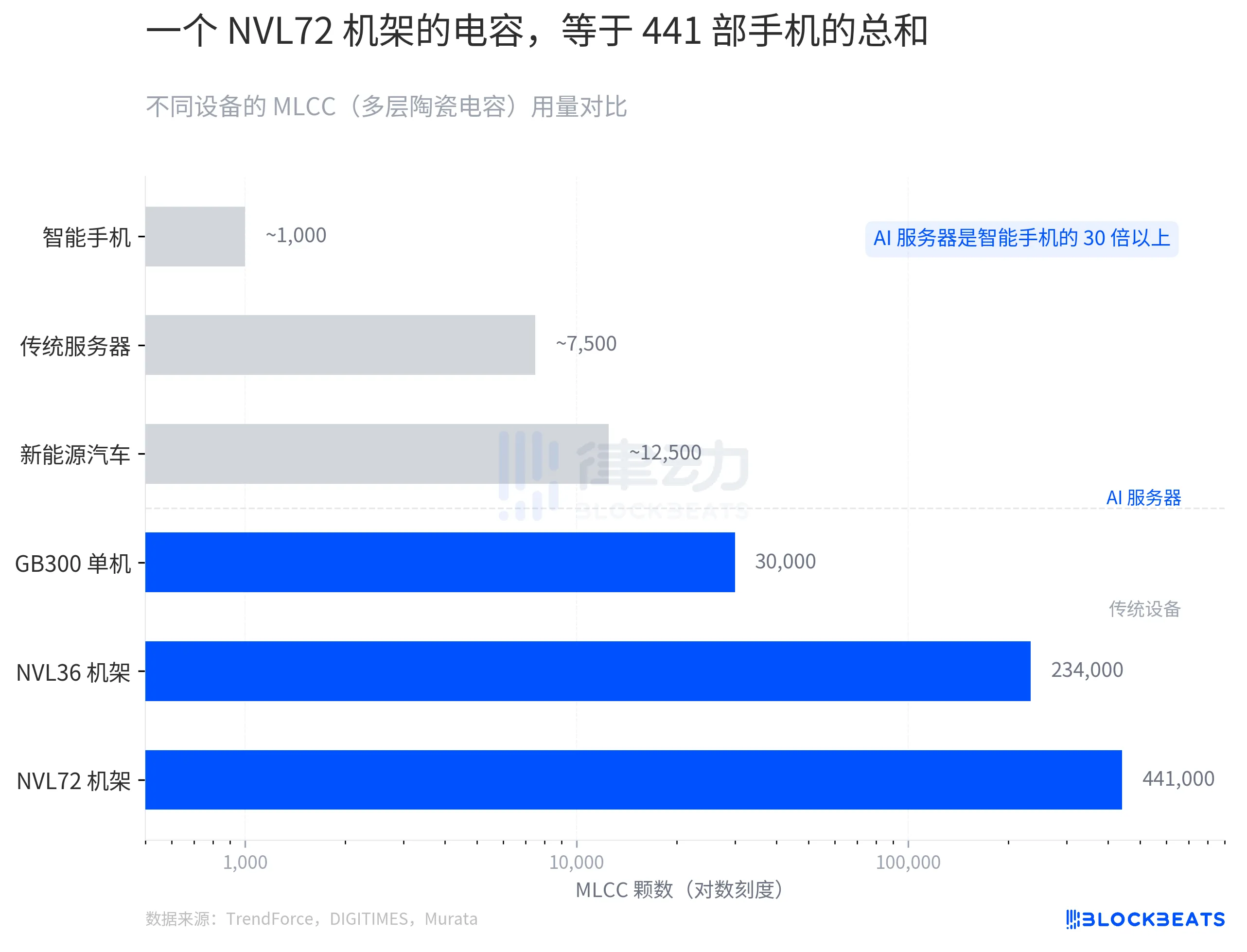
Looking at the entire rack level, the numbers become even more staggering. An NVL36 rack requires about 234,000 MLCCs, while an NVL72 rack needs about 441,000 MLCCs, resulting in MLCC costs per rack ranging from $2,500 to $4,600. MLCCs have risen to become the third-largest cost item in AI server BOMs, following only the GPU and memory.
The absolute value of $4,600 may sound insignificant compared to the tens of thousands of dollars for a GPU. However, the uniqueness of MLCCs lies in the fact that they are a "no-boot without one" rigid requirement. Cloud providers cannot halt the entire GPU production line due to a few capacitors.
Two Companies Capture 84% of the Market
The concentration of the MLCC market is high, but where it is high depends on which segment you look at.
According to TrendForce data, in the global MLCC market, Murata holds over 40% of the share, Samsung Electro-Mechanics of South Korea around 18%, TDK around 12%, and Japan's Taiyo Yuden and Taiwan's Yageo each around 10%. The top six companies collectively account for 70% of the global market share.
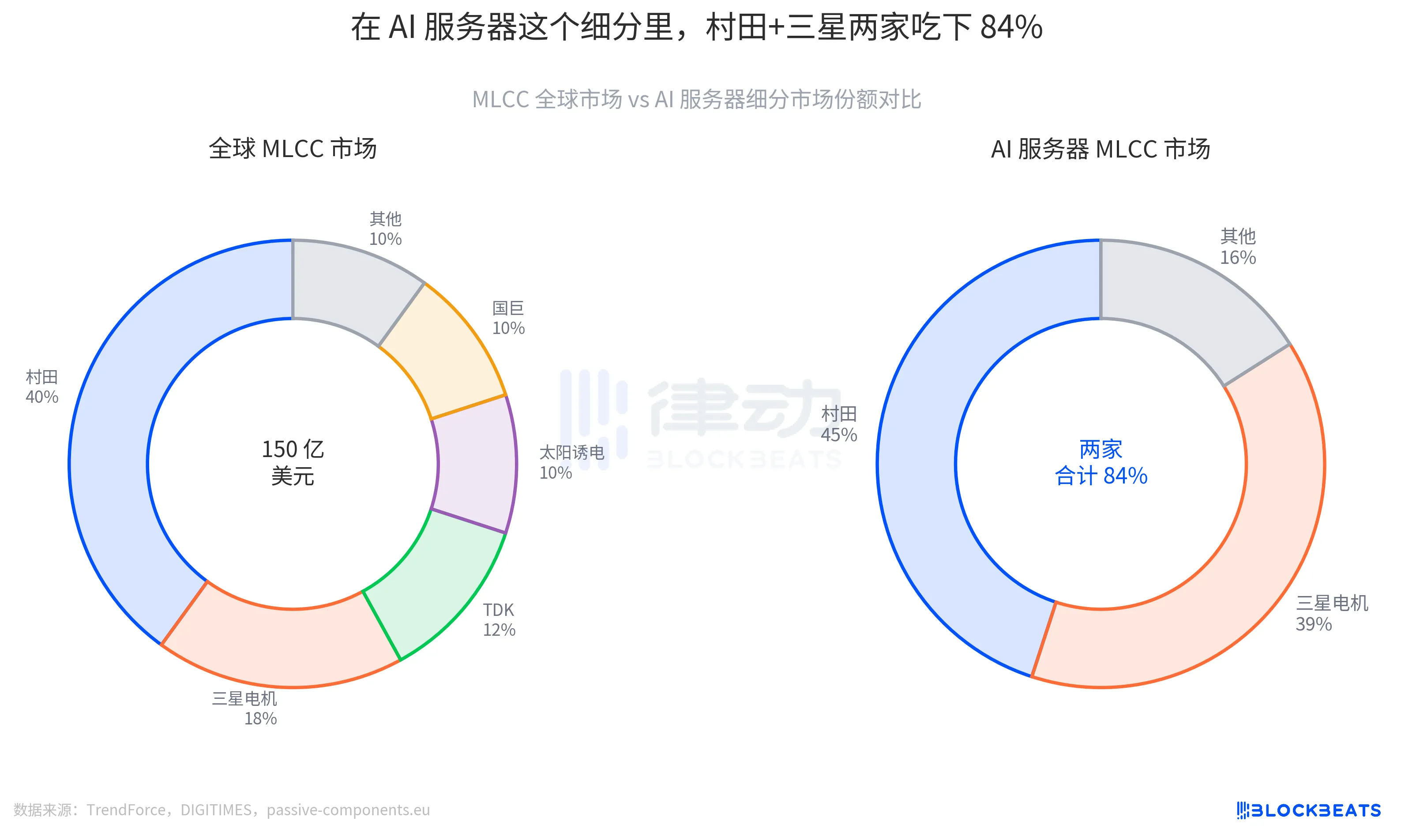
However, when it comes to the AI server submarket, the landscape is entirely different. According to the same source, Murata leads with a 45% share, closely followed by Samsung Electro-Mechanics at 39%, with the two companies together accounting for 84%. This means that in the global AI server supply chain, the supply of MLCCs is held by these two companies, with a concentration level surpassing that of the GPU market.
A notable competitive variable is Chinese manufacturers. According to passive-components.eu, the global revenue share of Chinese MLCC manufacturers reached 10% in the second half of 2024, up 4 percentage points from 2019. However, in the high-end specification segment required for AI servers, Chinese manufacturers currently have little presence.
Price Increase During Profit Margin Rock Bottom
Murata chose to raise prices at this time, driven by clear financial motives.
According to Murata Manufacturing Co.'s financial report, the company reached a recent peak in FY2022 (ending March 2023), with revenue of 1.81 trillion yen and an operating profit margin of 23.4%. Subsequently, the margin declined for two consecutive years. In FY2024 (ending March 2025), the operating profit margin fell to 13.1%, almost halved. The main reason for profit erosion was the intense price war from Chinese competitors in the mid-to-low-end market.
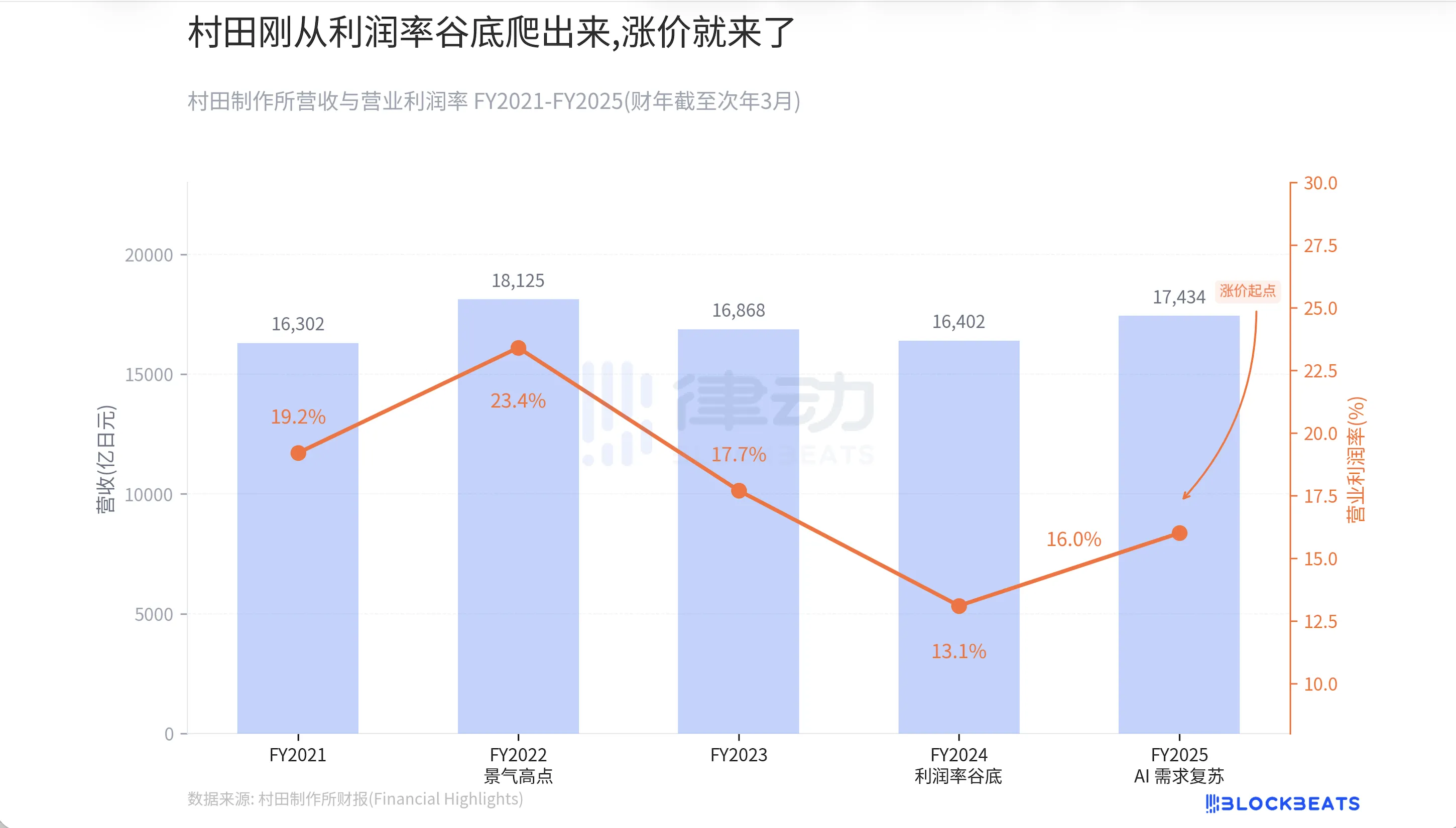
A turning point occurred in FY2025 (ending March 2026). The demand for AI servers drove an increase in shipments of high-end MLCCs, and Murata expects full-year revenue to recover to 1.74 trillion yen and the operating profit margin to improve to 16.0%. Murata President Norio Nakajima previously stated at an earnings briefing that demand for AI server-related MLCCs is expected to double in FY2025.
Announcing a price increase when the profit margin has just crawled out of its trough indicates that this is not simply a matter of "rising due to supply unable to meet demand." Murata needs to restore its thinning profit margin that was impacted by the price war, and the essential demand for AI servers has given it the confidence to raise prices.
The Last MLCC Price Hike Wave Lasted Two Years
This is not the first time the MLCC industry has gone through a price hike cycle. From early 2017 to mid-2018, the MLCC market experienced a "super price hike cycle," with prices of standard specification products rising 5 to 10 times, and lead times extending from the normal 4 to 8 weeks to over 30 weeks. The driving force behind that cycle was the dual pull of smartphones and automotive electronics, combined with Japanese manufacturers shifting capacity from standard products to high-end, causing severe shortages in the mid-to-low-end market.
The situation in 2026 is both similar to and different from 2017-2018. The similarity lies in the fact that major players proactively adjusted their product portfolios to shift capacity toward high-profit areas. The difference is that the MLCC demand for AI servers has shown a more sustainable growth trend compared to that of smartphones in those years. According to TrendForce, the spot price of high-end AI server-grade MLCCs has already risen by 15-20%, with a projected full-year increase of 30-40%. However, consumer-grade MLCC prices have remained relatively stable, with no panic-driven price surge across all product categories like in 2017.
After Murata's price hike, whether competitors such as Samsung Electro-Mechanics, Sunlord, and Yageo will follow suit will determine the intensity of this cycle. If only Murata adjusts its prices, the impact can be managed. However, if the entire industry raises prices together, the cost pressure on the AI server supply chain will spread from GPUs to every inconspicuous small component.
Individually, an MLCC is less than a millimeter in size, but when 441,000 of them are stacked together, they form an indispensable supply chain node on NVIDIA's NVL72 rack.
You may also like
Circle CEO responds to OUSD's challenge: Stablecoins are a winner-takes-all business, and we will not slow down
Argentina vs Cape Verde: When a Record-Breaking Legend Meets an Unbreakable Underdog
WEEX exclusive pre-match analysis of Argentina vs Cape Verde, exploring Messi-led Argentina’s dominance and Cape Verde’s historic defensive breakout, with a breakdown of volatility, structure, and match dynamics.
How does Gate redo "buying and selling stocks" from the cryptocurrency world to the stock market?
Former ByteDance employee's account: How I started with two Pinduoduo hard drives and made six times the profit with Seagate to achieve financial freedom?
Visa and Mastercard join 140 giants to launch a new stablecoin, but the impact on the market landscape may still be limited
WEEX Launches Depth Chart for Spot Trading
MiCA reshuffle begins, Binance temporarily bids farewell to the EU
Raising interest rates to protect STRC and selling coins to maintain credit, this time the strategy has chosen the two most expensive paths
Morning Report | Samsung announces a 265.5 trillion won investment plan, focusing on semiconductor and AI computing power data centers; Vitalik publishes an article detailing the entire technology tree behind the confusion protocol (iO) mainline
In the era of AI, what is left of Bitcoin?
NeoSoul announced plans to integrate with the OKX Agentic Wallet, promoting AI agents' participation in the on-chain economy
Why Is Bitcoin Lagging Stocks in 2026? AI Stocks, ETF Outflows, and the Nasdaq Rally Explained
What you bought on CEX is really not US stocks: Analyzing the 94% liquidation monopoly and the evaporation of equity under a five-layer pipeline
In such a crowded cross-border payment arena, where is the next stop for the future?
Why Is Bitcoin Down in 2026? What We Can Learn From 2022
The large models in the United States are moving towards closure in the name of security
From the white-haired stock god to the billionaire fund mogul, the smart people shorting Nvidia are all getting rich using the same framework
Morning Report | CoinEx becomes a key hub for Iran to evade sanctions, involving over $3.8 billion in funds; Kalshi seeks a new round of financing, with a valuation potentially rising to $40 billion
Circle CEO responds to OUSD's challenge: Stablecoins are a winner-takes-all business, and we will not slow down
Argentina vs Cape Verde: When a Record-Breaking Legend Meets an Unbreakable Underdog
WEEX exclusive pre-match analysis of Argentina vs Cape Verde, exploring Messi-led Argentina’s dominance and Cape Verde’s historic defensive breakout, with a breakdown of volatility, structure, and match dynamics.
How does Gate redo "buying and selling stocks" from the cryptocurrency world to the stock market?
Former ByteDance employee's account: How I started with two Pinduoduo hard drives and made six times the profit with Seagate to achieve financial freedom?
Visa and Mastercard join 140 giants to launch a new stablecoin, but the impact on the market landscape may still be limited
WEEX Launches Depth Chart for Spot Trading