
In just 70 days, Polymarket easily raked in tens of millions in fees

Original Title: "In Just 70 Days, Polymarket Easily Takes Away Millions of Dollars in Fees"
Original Author: Azuma, Odaily Planet Daily
On January 6th this year, Polymarket officially bid farewell to the "zero fee" model, starting to charge transaction fees from the "15-minute cryptocurrency price change" market. The specific fee rate will vary with real-time market odds— the closer the odds are to 0% or 100%, the lower the fee; conversely, the closer the odds are to 50%, the higher the fee, reaching a maximum of 1.56%.
Later, on January 28th, about three weeks after the fee implementation, we published an article titled "Data Calculation: Polymarket's Annual Revenue Easily Exceeds $100 Million, Assuming...". The article made a static estimate based on Polymarket's trading volume and trading activity structure at the time: in the most conservative scenario, assuming the fee-charging market remains the same, it is estimated that Polymarket could generate approximately $38 million in revenue per year; and in the most aggressive scenario, if Polymarket expands fees to all markets, an estimated annual fee income of $418 million.
In our previous revenue estimate for Polymarket, we were frustrated by the short observation period and too few calculable samples. Now, two months later, we have re-estimated Polymarket's revenue expectations with richer data. The results show that the so-called "conservative" estimate is indeed too conservative, and the so-called "aggressive" expectation is not overly exaggerated.
Revenue Data Changes
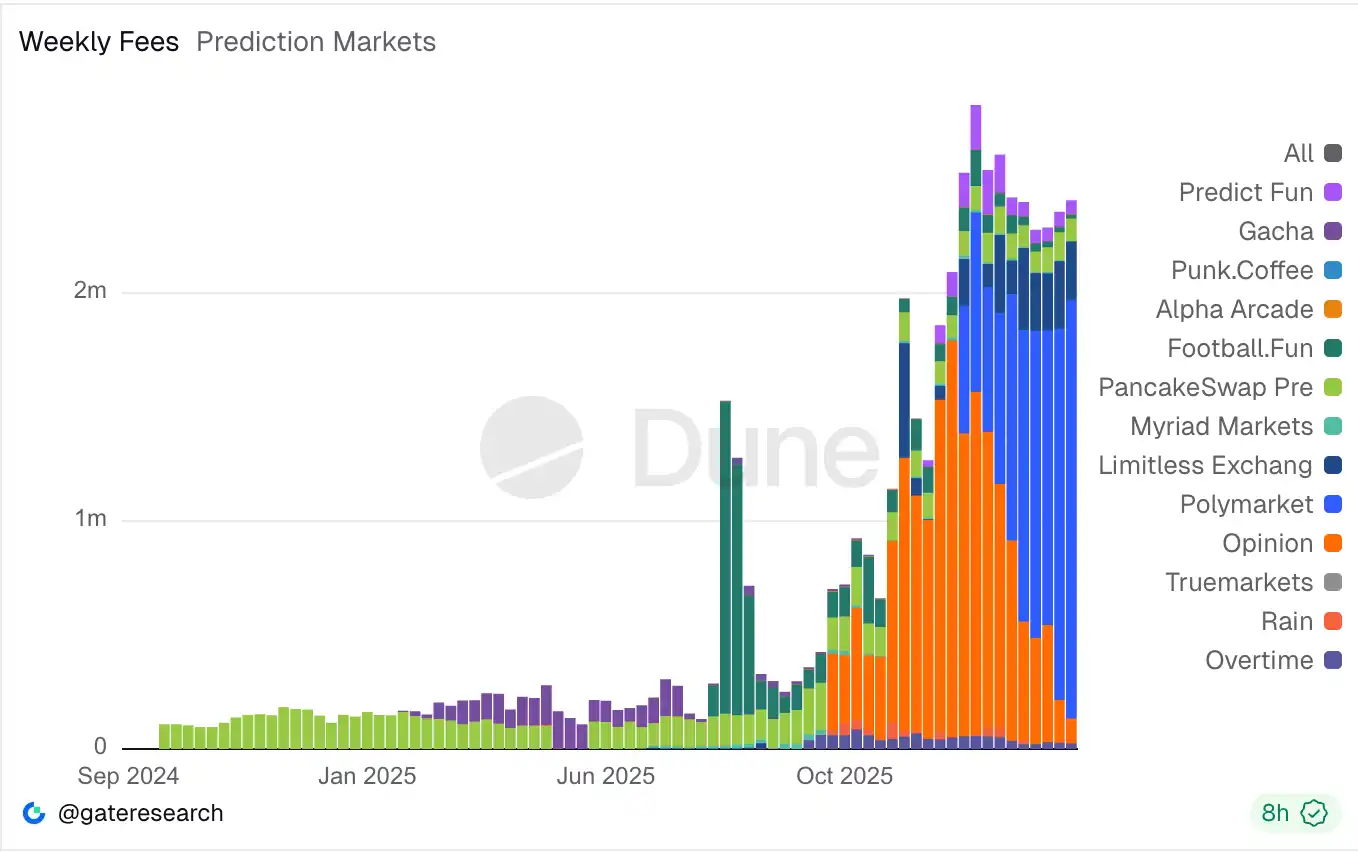
According to data compiled by Gate Research on Dune, since the introduction of transaction fees on January 6th, Polymarket has accumulated over $11.2 million in fee revenue.
By once again making a static estimate in the most conservative manner, assuming that market trading volume and activity structure remain unchanged, it is projected that Polymarket could generate approximately $58.4 million in revenue annually.
However, this estimation method does not accurately reflect Polymarket's revenue capabilities.
The reason is that Polymarket's revenue data is visibly growing— in the past 10 weeks, the platform's fee revenue has been $560,000, $786,000, $633,000, $749,000, $1.08 million, $1.28 million, $1.35 million, $1.29 million, $1.63 million, $1.84 million... almost showing significant growth every week.
Reasons for Revenue Growth
The growth in Polymarket's fee revenue can be attributed to two main factors. First, Polymarket has expanded the scope of fee-charging markets. Second, both Polymarket's overall trading volume and fee-charging market volume have continued to grow.
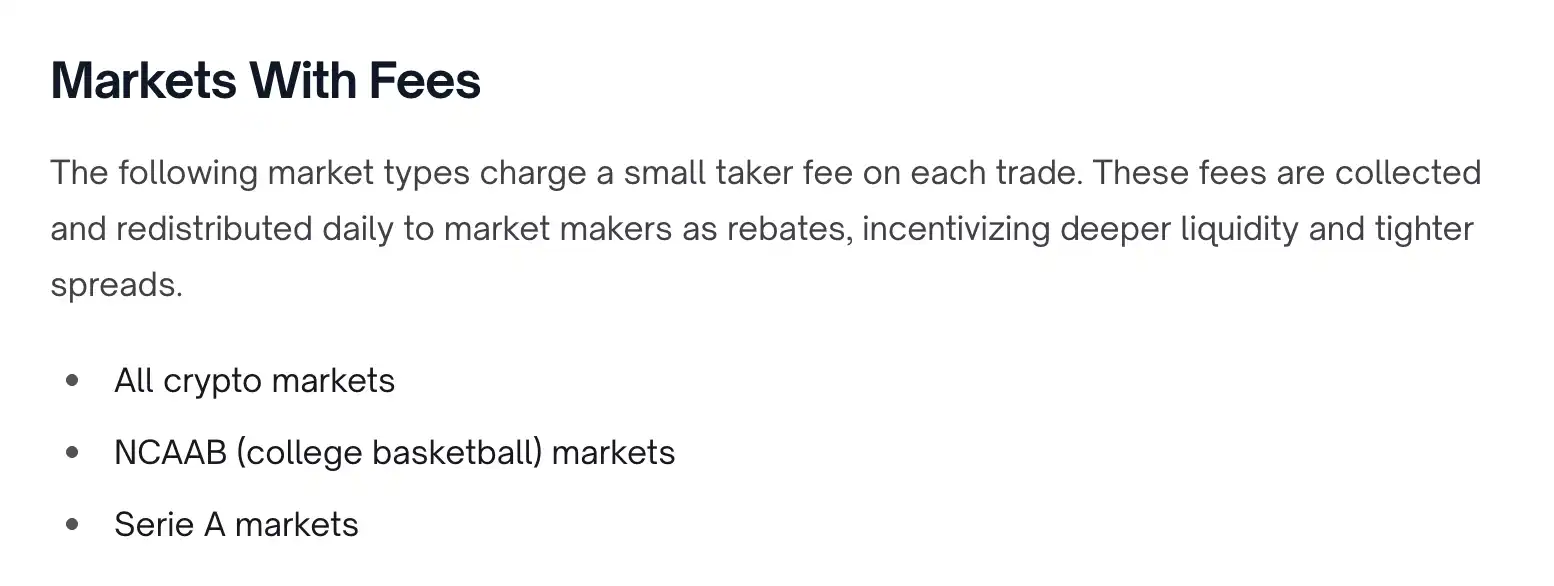
Regarding the scope of fee-charging markets, on March 6, Polymarket expanded its fee mechanism to all cryptocurrency-related markets. Additionally, earlier trials of fee collection were conducted in sports markets such as NCAA and Serie A, but the former (cryptocurrency-related markets) currently remains the main source of fee revenue.
With respect to trading volume, the data dashboard below, created by Data Dashboards on Dune, shows that Polymarket's overall weekly trading volume, including the cryptocurrency market (bottommost purple bar), has been steadily increasing.
Future Revenue Forecast
The last time we estimated Polymarket's revenue, we had to manually calculate the percentage of "15-Minute Cryptocurrency Price Change" related markets as a share of all cryptocurrency-related market volume. However, Polymarket has now expanded fees to all cryptocurrency-related markets as of March 6, making this estimation much more convenient. As for NCAA and Serie A, either because the former has not yet entered the "March Madness" formal tournament stage or the latter does not attract much attention in American culture, the trading volume of related markets is significantly lower compared to cryptocurrency, so we will temporarily ignore them.
Using the data from the first complete week after March 6 (3.9-3.15), the share of cryptocurrency-related event trading volume in Polymarket's total platform volume was 26.7% for that week. In the same week, Polymarket's fee revenue was approximately $1.84 million. Based on this static proportion, at the current level of trading volume and transaction structure, if Polymarket introduces a similar fee model to all markets, it is estimated that this platform could generate $360 million in annual revenue.
The Money Printer Is Running
It is worth noting that as a key initiative to enhance liquidity on Polymarket, the platform has distributed a total of $13.41 million in subsidies to liquidity providers (LPs) to date. As a comparison, if the data for the remaining days of March maintains the performance of the first half of the month, the fee revenue from Polymarket this month would be sufficient to cover the total expenditure on liquidity subsidies.

Polymarket has already essentially proven the revenue potential of this new format of prediction markets, and future revenue growth will largely depend on two variables - how much further trading volume can grow, and whether fees can be further extended to more markets.
If these two variables continue to rise, prediction markets could perhaps become the simplest, most straightforward “money printer” in the cryptocurrency industry.
You may also like

Former ByteDance employee's account: How I started with two Pinduoduo hard drives and made six times the profit with Seagate to achieve financial freedom?
MiCA reshuffle begins, Binance temporarily bids farewell to the EU
How does Gate redo "buying and selling stocks" from the cryptocurrency world to the stock market?
Visa and Mastercard join 140 giants to launch a new stablecoin, but the impact on the market landscape may still be limited
Circle CEO responds to OUSD's challenge: Stablecoins are a winner-takes-all business, and we will not slow down
Argentina vs Cape Verde: When a Record-Breaking Legend Meets an Unbreakable Underdog
WEEX exclusive pre-match analysis of Argentina vs Cape Verde, exploring Messi-led Argentina’s dominance and Cape Verde’s historic defensive breakout, with a breakdown of volatility, structure, and match dynamics.
WEEX Launches Depth Chart for Spot Trading
Raising interest rates to protect STRC and selling coins to maintain credit, this time the strategy has chosen the two most expensive paths
Morning Report | Samsung announces a 265.5 trillion won investment plan, focusing on semiconductor and AI computing power data centers; Vitalik publishes an article detailing the entire technology tree behind the confusion protocol (iO) mainline
In the era of AI, what is left of Bitcoin?
NeoSoul announced plans to integrate with the OKX Agentic Wallet, promoting AI agents' participation in the on-chain economy
Why Is Bitcoin Lagging Stocks in 2026? AI Stocks, ETF Outflows, and the Nasdaq Rally Explained
What you bought on CEX is really not US stocks: Analyzing the 94% liquidation monopoly and the evaporation of equity under a five-layer pipeline
In such a crowded cross-border payment arena, where is the next stop for the future?
Why Is Bitcoin Down in 2026? What We Can Learn From 2022
The large models in the United States are moving towards closure in the name of security
From the white-haired stock god to the billionaire fund mogul, the smart people shorting Nvidia are all getting rich using the same framework
Morning Report | CoinEx becomes a key hub for Iran to evade sanctions, involving over $3.8 billion in funds; Kalshi seeks a new round of financing, with a valuation potentially rising to $40 billion
Former ByteDance employee's account: How I started with two Pinduoduo hard drives and made six times the profit with Seagate to achieve financial freedom?
MiCA reshuffle begins, Binance temporarily bids farewell to the EU
How does Gate redo "buying and selling stocks" from the cryptocurrency world to the stock market?
Visa and Mastercard join 140 giants to launch a new stablecoin, but the impact on the market landscape may still be limited
Circle CEO responds to OUSD's challenge: Stablecoins are a winner-takes-all business, and we will not slow down
Argentina vs Cape Verde: When a Record-Breaking Legend Meets an Unbreakable Underdog
WEEX exclusive pre-match analysis of Argentina vs Cape Verde, exploring Messi-led Argentina’s dominance and Cape Verde’s historic defensive breakout, with a breakdown of volatility, structure, and match dynamics.