
Grayscale Submits IPO Application: Cryptocurrency Giant with $35 Billion AUM Finally at the Doorstep of the Stock Market

Original Article Title: "Grayscale, Once Tough SEC, is about to Land on the NYSE"
Original Article Author: Eric, Foresight News
On the evening of November 13th, Beijing time, Grayscale submitted an IPO application to the NYSE, planning to debut on the US stock market through Grayscale Investment, Inc. This IPO is led by Morgan Stanley, BofA Securities, Jefferies, and Cantor.
It is worth noting that Grayscale's listing this time adopts an Umbrella Partnership structure (Up-C). In this structure, Grayscale's operational and controlling entity, Grayscale Operating, LLC, is not the listing entity. Instead, the IPO is conducted through a newly established listing entity, Grayscale Investment, Inc., which acquires a portion of LLC's equity to facilitate public trading. The company's founders and early investors can convert their LLC interests into shares of the listing entity, enjoying capital gains tax benefits in the process by only paying personal income tax. IPO investors, on the other hand, need to pay taxes on corporate profits and personal income tax on stock dividends.
Such a listing structure not only benefits the company's "elders" in terms of taxation but also allows for post-listing absolute control through dual-class shares. The S-1 filing shows that Grayscale is wholly owned by its parent company DCG, and Grayscale explicitly states that post-listing, the DCG parent company will retain decision-making control over Grayscale through 100% ownership of B class shares with greater voting rights. The funds raised through the IPO will also be used entirely to purchase equity from the LLC.
Everyone is no stranger to Grayscale, which first launched Bitcoin and Ethereum investment products and, through a tough battle with the SEC, achieved the conversion of Bitcoin and Ethereum trusts into spot ETFs. Its launch of the Digital Large Cap Fund also had the power of a "cryptocurrency version of the S&P 500." During the last bull market cycle, every adjustment to the large-cap fund caused significant short-term price fluctuations for the tokens being removed and added.
S-1 filings show that as of September 30th of this year, Grayscale's total AUM reached $35 billion, making it the world's largest cryptocurrency asset manager. It has over 40 different digital asset investment products covering more than 45 cryptocurrencies. The $35 billion includes $33.9 billion in AUM of ETPs and ETFs (primarily Bitcoin, Ethereum, SOL-related products) and $1.1 billion in private funds (primarily altcoin investment products).
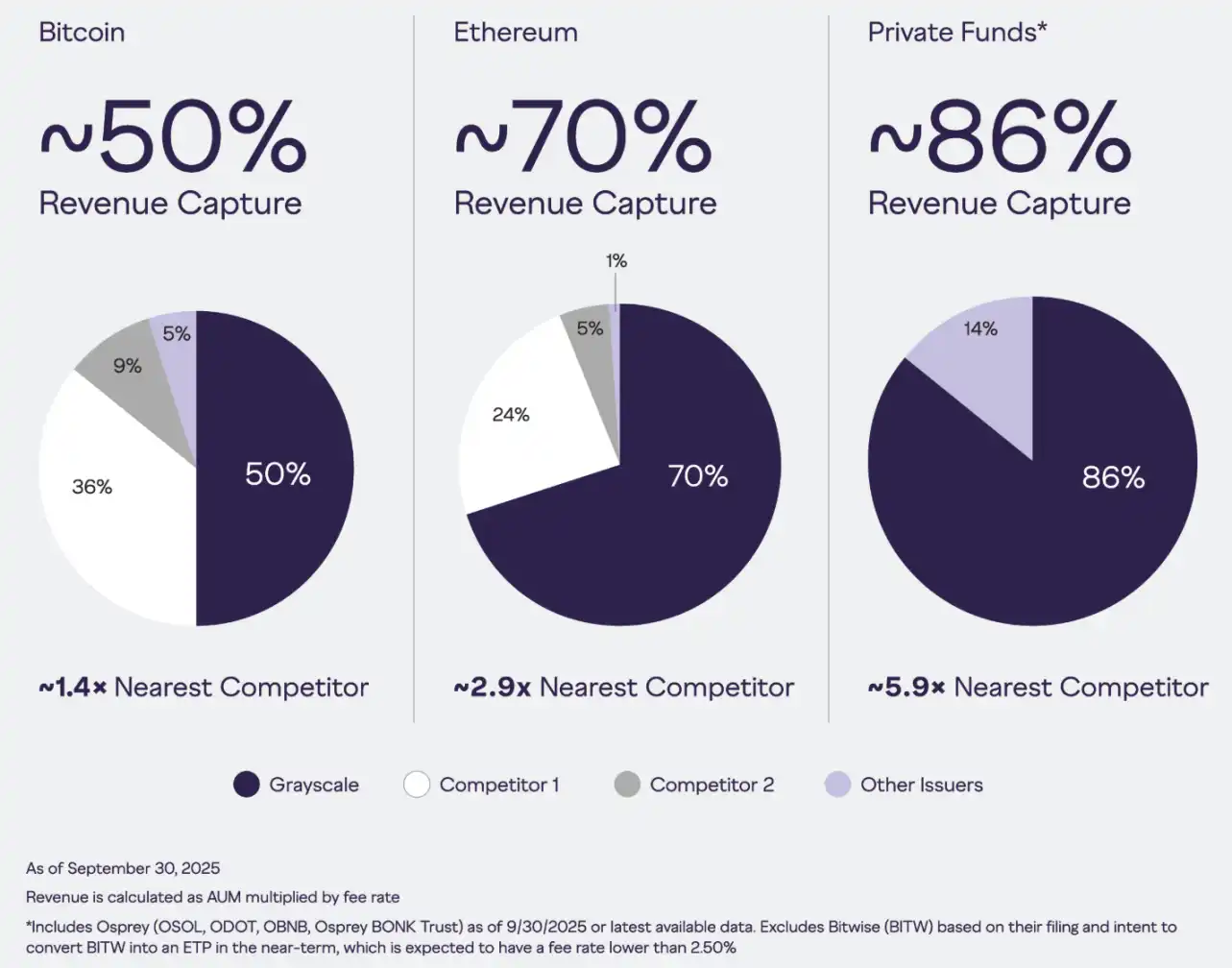
In addition, purely in terms of revenue, Grayscale's main investment products have a stronger revenue-generating capability compared to its primary competitors. However, this is mainly due to the previously non-redeemable trust accumulation of AUM and an above-peer-average management fee.
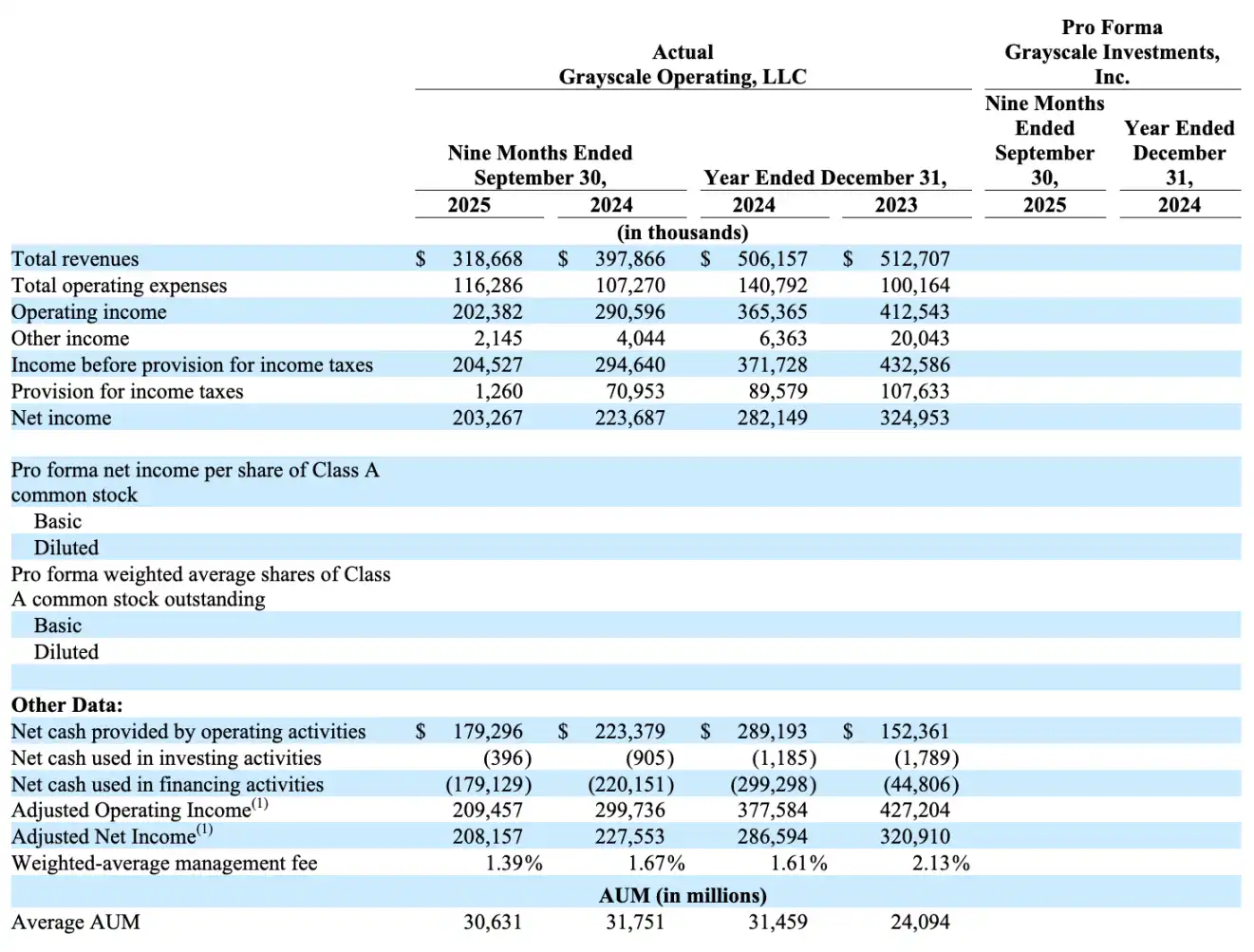
Financially, for the nine months ending September 30, 2025, Grayscale's operating revenue was approximately $3.19 billion, a 20% year-over-year decrease. Operating expenses were around $1.16 billion, an 8.4% year-over-year increase. Operating profit stood at about $2.02 billion, a 30.4% year-over-year decrease. Including other income and deducting the provision for income taxes, the net profit was approximately $2.03 billion, down 9.1% year-over-year. Additionally, average AUM data indicates a possible decrease in AUM compared to last year.
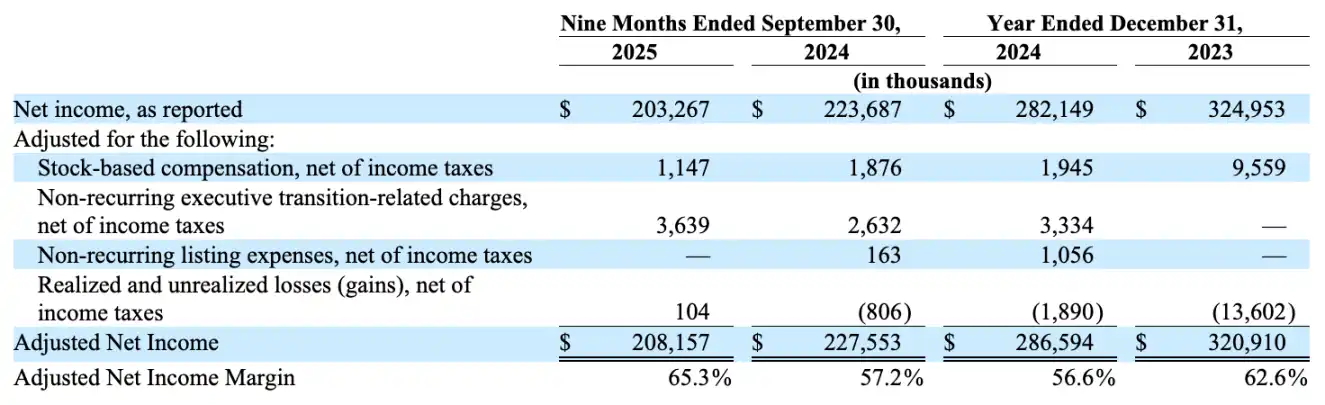
Excluding non-recurring items, the adjusted net profit for the reporting period was about $2.08 billion, with a net profit margin of 65.3%. Although the former decreased by 8.5% year-over-year, the net profit margin increased compared to the same period last year at 57.2%.
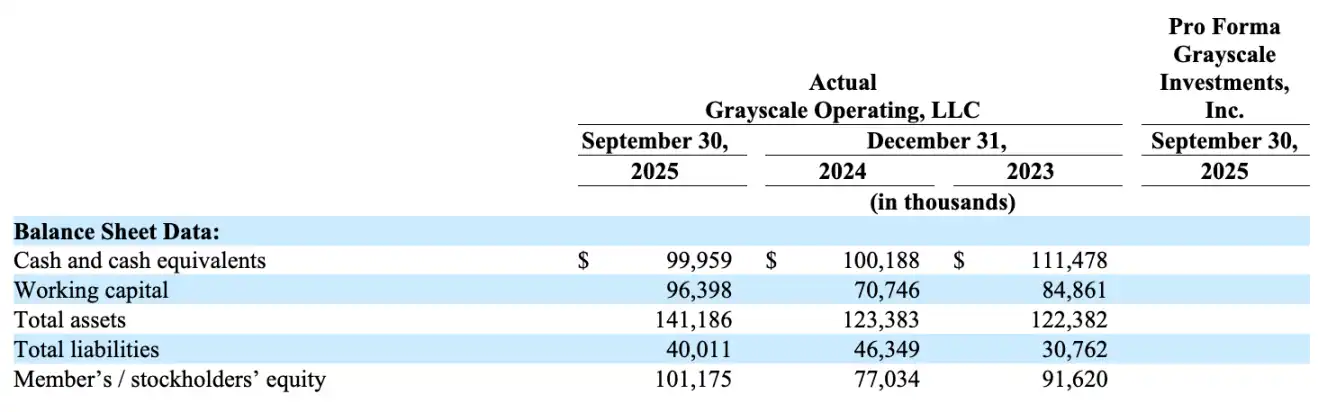
Currently, Grayscale's debt ratio is quite healthy. Despite a decline in revenue and profit, considering the increase in company asset value, decrease in debt, and improvement in profit margin, Grayscale's operational condition is continuously improving.
The S-1 filing also disclosed Grayscale's future development plans, including expanding the types of private funds (introducing more altcoin private investment products); launching active management products to complement passive investment products (ETFs, ETPs); conducting active investments targeting its own investment products, cryptocurrencies, or other assets.
Regarding expanding distribution channels, Grayscale disclosed that it has completed due diligence on three broker-dealers with a total AUM of $14.2 trillion and recently launched Bitcoin and Ethereum mini ETFs on the platform of a large independent broker-dealer with over 17,500 financial advisors and consulting and brokerage assets exceeding $1 trillion. In August of this year, Grayscale partnered with the iCapital Network, a network of 6,700 advisory firms, under which Grayscale will provide digital asset investment channels through its active management strategies to the network companies in the future.
Overall, the information disclosed by Grayscale indicates that the company is a relatively stable asset management firm, with the main revenue source being management fees from investment products, offering limited room for imagination. However, given the precedents of traditional asset management companies going public, the expectations for Grayscale's market value, P/E ratio, etc., are somewhat foreseeable, providing a relatively predictable investment target.
You may also like

The large models in the United States are moving towards closure in the name of security

Morning Report | CoinEx becomes a key hub for Iran to evade sanctions, involving over $3.8 billion in funds; Kalshi seeks a new round of financing, with a valuation potentially rising to $40 billion

From the white-haired stock god to the billionaire fund mogul, the smart people shorting Nvidia are all getting rich using the same framework

Why do cryptocurrency projects always like to change their names?

Global Launch: As predictions become the most scarce asset in the AI era, Manadia is defining the next generation of the value internet

Who is footing the bill for the $64 billion accounting frenzy?
I never expected that the first application of AI x Crypto would be in security auditing

What is your view on Binance's competitive advantages?

ETH has entered a non-consensus phase, and the turning point is approaching!
The shift in the cloud of the air: from despising stablecoins a year ago to the high-profile entry of capital today
The survival dilemma of small and medium exchanges behind the withdrawal anomalies exposed by AscendEX
Why Is Bitcoin Falling Below $60K? 5 Key Market Drivers Explained
Bitcoin has dropped sharply amid ETF outflows, Strategy stock weakness, AI stock rallies, and changing Fed expectations. Explore the key forces driving BTC’s latest correction and what traders should watch next.

Bitcoin vs. Gold in 2026: Which Asset Performs Better in Different Markets?

Morning News | The draft amendment to the People's Bank of China Law aims to clarify the legal status of digital renminbi; South Korea will transfer about 40 unregistered virtual asset service providers to law enforcement agencies
The cryptocurrency industry has entered the "Show Me" era: merely relying on vision is no longer enough

Interpreting the Ethereum Foundation's new structure: Reaffirming self-sovereignty amid institutional trends
Former SpaceX engineer reconstructs the financial execution system using first principles
Standard Chartered Bank sings a 50x rhapsody again, aiming for AAVE to reach 3500 USD
The large models in the United States are moving towards closure in the name of security
Morning Report | CoinEx becomes a key hub for Iran to evade sanctions, involving over $3.8 billion in funds; Kalshi seeks a new round of financing, with a valuation potentially rising to $40 billion
From the white-haired stock god to the billionaire fund mogul, the smart people shorting Nvidia are all getting rich using the same framework
Why do cryptocurrency projects always like to change their names?
Global Launch: As predictions become the most scarce asset in the AI era, Manadia is defining the next generation of the value internet
Who is footing the bill for the $64 billion accounting frenzy?

Popular coins
Latest Crypto News


